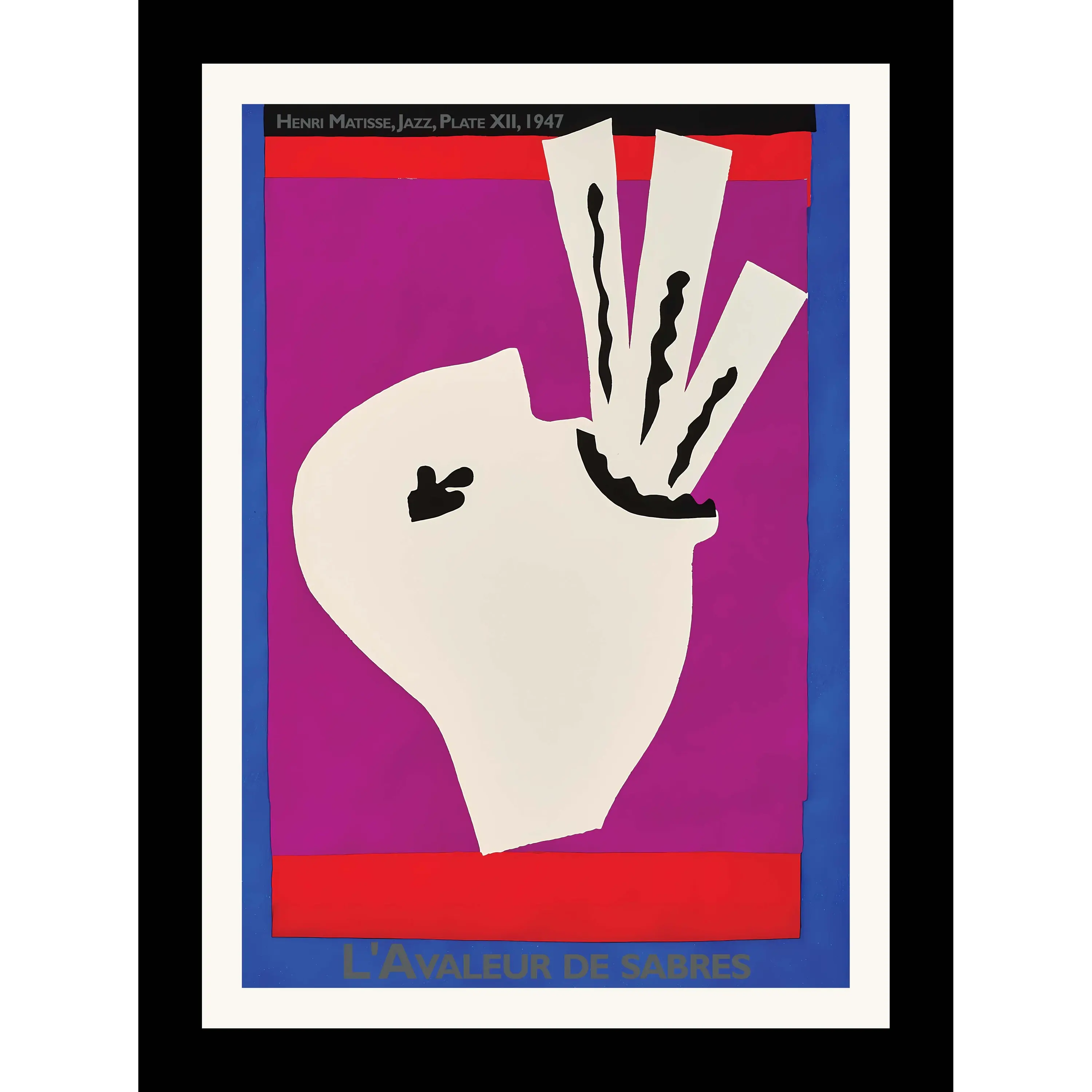

The Sword Swallower is a quintessential example of Matisse’s "Jazz" portfolio, a collection that fundamentally redefined the relationship between book arts and modern painting. By 1947, Matisse was utilising his "cut-out" technique almost exclusively, finding that the physical act of slicing through vivid, gouache-painted paper allowed him to "draw with light". This specific plate captures the theatrical tension of a circus performer, rendered through a radical economy of form and a daring, non-naturalistic colour palette. The composition centres on a large, white silhouette that represents the head of the performer, tilted back in a moment of stylised intensity. The three jagged, vertical forms protruding from the "mouth" serve as a rhythmic abstraction of swords, their black serrated interiors suggesting both the danger of the act and a visual vibration similar to a musical beat. The choice of a deep purple background set against a vibrant red border creates a chromatic vibration, a "visual jazz", that echoes the improvisational energy of the era's music. Matisse wasn't interested in a literal depiction of a circus act; he was capturing the feeling of the performance. Through these bold, flat planes of colour, he managed to convey a sense of movement and drama that remains strikingly modern today.
Studio Gallery Frame in 'black'; acrylic safety fronts; ready-to-hang options.
Gift-ready, arriving hand-wrapped in acid-free tissue paper. Plastic-free packaging.
Image source: OpenSource CC0.
Copyright 2026 artforall.studio trading as Mercia Mercantile Limited.
Home & Garden > Decor > Artwork > Posters, Prints, & Visual Artwork
%2C+Henri+Matisse%2C+1947)